The beat . A blog by premiumbeat

February 12, 2013
Author:
Categories:
PremiereTutorialsVideo Editing

Creating Beautiful Slow Motion in Adobe Premiere Pro

Slow-motion video can be very beautiful if used correctly. In this post, we’ll take an in-depth look at creating smooth slow-motion from 60p video in Premiere Pro.

Adobe Premiere Pro Slow Motion

Don’t make the mistake of slowing down standard frame rate video for slow motion.  It’ll look choppy and make you look like a total amateur.

Instead, to make smooth slow-mo, you’ll need to shoot your footage at a high frame rate and then play back your footage at a lower frame rate in your video editing app. Most DSLR’s have the capability to shoot 720p at 60 frames-per-second (fps). Shooting at 60 fps gives you the ability to play back your footage at a slower fps like 24 fps. So, in essence, your footage will be played back perfectly smooth with every frame accounted for at 40% speed. Still with me?  Good.

Take a look at this video shot completely in 60p and slowed down to 40%. Notice how there is no frame blending or skipping in the slow-mo:

In this tutorial, we’ll show you how to create a similar effect by conforming 60p footage to 24p in Premiere Pro. Unlike other video editing applications that make it complicated to get smooth slow-mo, it is really simple to create slow-motion in Premiere Pro.

There are 2 ways to slow down your 60p video in Premiere Pro…

Technique #1 – Slow down in your timeline

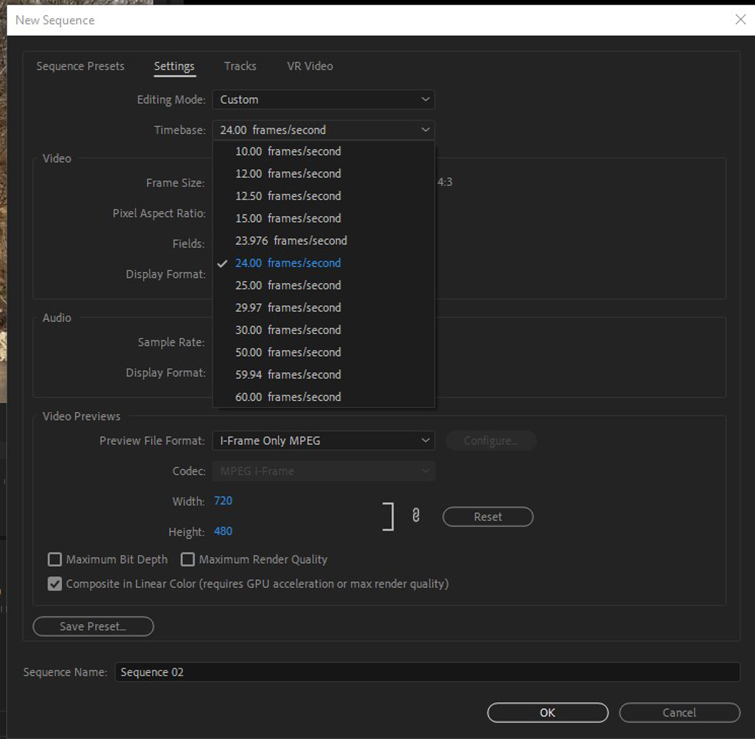
This one is simple and straightforward. Create a 24p sequence.

Premiere-Pro-24p-sequence

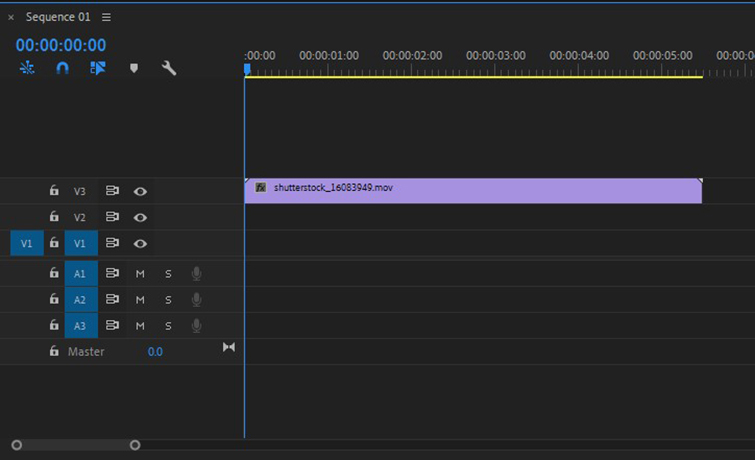
Place a 60p clip in your 24p timeline.

Premiere-Pro-slow-motion-timeline

Right click the clip and make sure frame blending is OFF.

Premiere-Pro-Frame-Blend-unchecked

Right click the clip and go to “Speed/Duration” (⌘R).

Premiere-Pro-Speed-Duration

Set your speed to 40%.

Premiere Pro Speed change to 40%

NOTE: If you are working in a different frame rate other than 24 fps, you will have to determine your speed by dividing your destination frame rate by your clip’s frame rate. Ex: 24/60=.4

Now you footage is in smooth slow-motion. You’ll notice that every frame is played back and there is no frame blending. Beautiful!

Technique #2 – Re-interpret frame rate

This is the way I usually conform 60p clips into slow-mo. This is also a good way to make multiple clips slow-mo in one simple step. This will make the selected clips in your bin slow-motion, so if you want to keep your original 100% speed clips in your project, you’ll want to duplicate them before doing this.
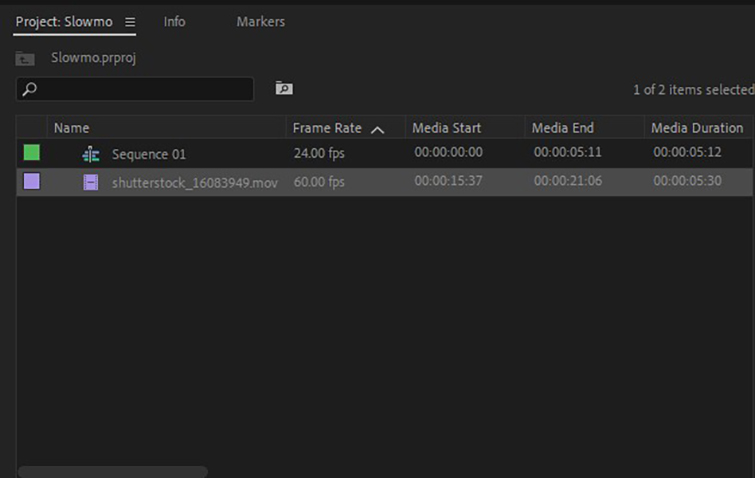
Select your clips in your bin that you want to make slow-mo.

Premiere Pro close motion clips selected

Right click and select “Modify>Interpret Footage.”

Premiere Pro Interpret footage

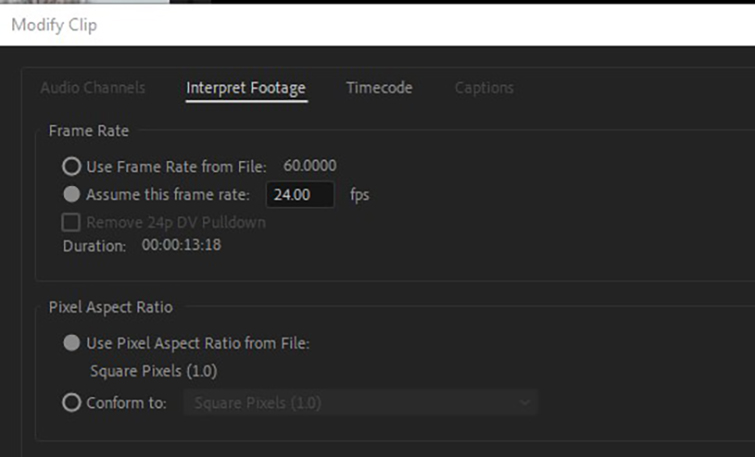
Select “Assume this frame rate” and set the value to your timeline’s frame rate.

Premiere-Pro-Assume-framerate

Done. Now, all the selected clips will play back in slow-mo. Pretty neat.

By using these simple techniques, using 60p video to create slow-motion in Premiere Pro is super easy. Slow-motion footage is a great way to add emotion and style to any video project.

Got Premiere Pro tips to share?
Let us know in the comments below!

Need Royalty Free Tracks?

Browse our Exclusive Music Library

Related Posts:

  • Steven Peterson

    If I use 720p 60fps video for my slow-mo shots and use 1080p 24fps for my interview clips (for example), how can I use the 720p footage w/o stretching/scaling it? Will I have to export the entire video to 720p? Should I just invest in a camera that can handle 1080p 60fps?

    • http://www.cineblur.com Brent Pierce

      Hey Steven, what I usually do is simply scale up the 720p footage to 1080p in your timeline to match the rest of your interview clips. That way, your exported video will be 1080p.

      But, if your output video is only going to be streamed via the internet (Vimeo, Youtube), then there really is no need to export to 1080p, as Vimeo and Youtube compress your video and usually only playback as 720p anyways. So, if you are worried about loosing quality in your 720p clips, you might as well scale your 1080p footage down to 720p so you don’t loose quality in your footage.

      But again, I usually just scale my 720p clips up.

      I wouldn’t worry about investing in a 1080p 60fps camera; they can be pretty pricey.

      • Steven Peterson

        Won’t the slow-mo shots look a little fuzzy? Maybe I’m just over-reacting. I’ve never scaled up any of my footage. Never had a reason. I’ll go make a reason and then try it out. Maybe a proper tutorial on scaling up footage is in order?

        • http://www.cineblur.com Brent Pierce

          Yes, it will loose a bit of quality, but probably not hugely noticeable, especially if it will only be played on an internet stream.

          If you are REALLY worried about loosing quality, just make your timeline 720p and scale down your 1080p footage.

          • Steven Peterson

            I could get away with shooting the entire thing in 720P then. Fits more footage on a card. I could take any shot and make it into a smooth slow-mo. No scaling required. Interesting.

          • John Young

            Steven. Be aware that 60p footage has a very ‘video-y’ look to it. It doesn’t have that cinematic motion blur that 24p footage has. Do some test shooting and put 24p footage right beside 60p footage and you will see what I mean.

          • Steven Peterson

            hmm…while we’re on the video-y vs film look topic. When I shoot an interview, should I shoot in 24fps, 30fps, or 60fps? I mean, it’s not for a film or anything…more of a pre-wedding talking head I guess. I love 24fps to death, but I’m finding myself using it just to use it. I know Brent does a lot of church gigs. If you’re reading this, how do you choose what format to use? Is it situational, or do you use 24fps a lot too? Anyone can chime in. The more the better!

          • http://www.cineblur.com Brent Pierce

            That is a GREAT question that would be a good blog post.
            I use whatever the situation calls for. In interviews, most of the time I will shoot in 30p. For anything that I want to be cinematic, I will shoot 24p.

  • http://twitter.com/DARKWINGpro Darkwing Productions

    One other thing to keep in mind, you need more light to shoot in 60fps, because you usually want to try shoot at a shutter speed equal to twice your frame rate, which in this case would be 1/120. I shoot a lot of sports, and although I would love to use my 720×60 mode more often for the smooth slow-mo it can produce, but I find that the lighting often isn’t sufficient.

    When it comes to 24fps vs 30fps, I tend to go with 24fps if I need a tad more light (1/48 vs 1/60). It’s not a huge difference, but when you’re in a pinch, every little bit helps. I find you can barely notice the difference between 24fps and 30fps unless you’re dealing with a fast moving subject.

Become a better editor!