Canon Announces EOS R7 and EOS R10 – Compact APS-C Cameras

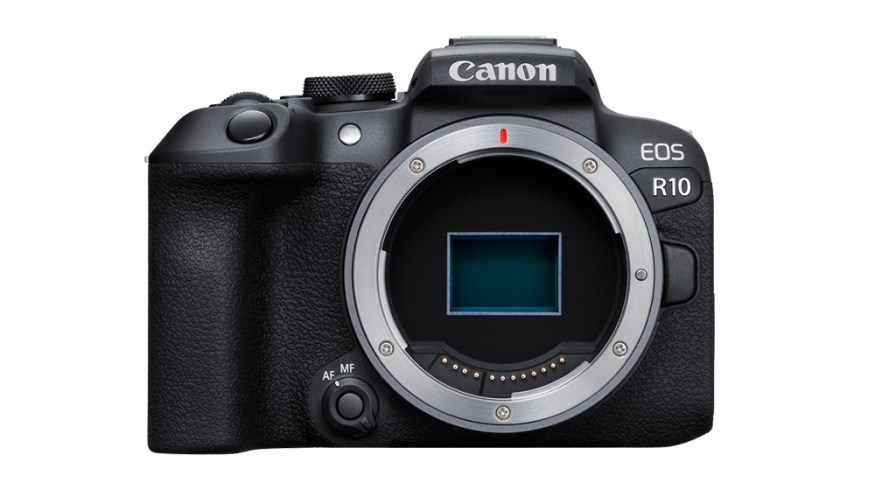
Canon has finally entered the APS-C mirrorless market with the EOS R7 and EOS R10. Check out the specs and see if these cameras are right for you.
Earlier this year, I converted from the medium format Pentax 645z to the RF Canon R5, and the camera has been a dream. I’ll touch upon my love affair with the R5 in a future article, but one thing to note is that the current line of cameras isn’t necessarily accessible for new users and hobbyists. Not only are the likes of the R5, R5 C, and R6 littered with professional features that come with a steep learning curve, the price line of the R series isn’t exactly budget-friendly.
Now, you do have the Canon RP which, when launched, was $1,299 (it has since slightly dropped in price), and that was just for the body. You can expect to pay at least $500 for a reasonably decent full-frame lens. So, the line wasn’t precisely entry-level friendly. Not in the way where you can buy a Canon Rebel series camera with a kit lens for less than $500 brand new.
Now Canon, to some extent, seeks to quash that with a new line of APS-C cameras. Today, they introduce the R7 and R10.

Canon R7 and Canon R10
Given that both cameras house an APS-C sensor, you can, of course, expect them to be a lot smaller and lighter than the full-frame line. But, given the R5 is ergonomically smaller than the 5D Mk IV DSLR, I’m not sure just how small these cameras are set to be.
Specs for both cameras:
- 32 million pixels (EOS R7) and 24 million pixels (EOS R10), APS-C size image sensor
- Autofocus (AF): subject detection inherited from EOS R3
- Up to 15 fps mechanical shutter
- First Canon APS-C camera with up to 7.0 stops Coordinated Image Stabilization
- Dual memory card slots (EOS R7 only)
- Full width 4K video recording at 60p (EOS R7 only), 30p and 24p
- Record each clip over 30 minutes
- Up to 30fps with electronic shutter (EOS R7 only)
- Dust and moisture resistant (EOS R7 only)
- In-body image stabilization (EOS R7 only
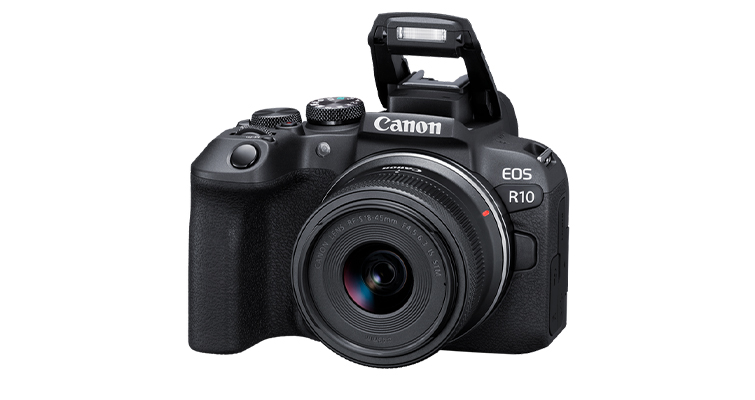
The Canon EOS R7 camera will be available for an estimated retail price of $1,499, and the Canon EOS R10 camera body will be available for an estimated retail price of $979.99.
We could associate the R7 to the likes of the initial 7D and the R10 to the T2I/Rebel line from these specs. While the R7 isn’t inherently the budget model I was pointing out in the intro, the R10 is undoubtedly heading in the right direction.
Perfect for those shooting on the move or hand-held for multiple seconds, the collaborative In-Body Image Stabilizer (IBIS) in the EOS R7 joins the EOS R6, EOS R5, and EOS R3 in offering the world’s highest level of image stabilization of 8.0 stops.
For the first time in EOS cameras, the IS system is used to level the horizon when the “Auto-level” feature is enabled, and it also compensates for vertical shake when shooting in the newly added panoramic or panning modes.
Offering extended reach, the newly designed 32.5 and 24.2-megapixel APS-C sensors within both EOS R7 and EOS R10 deliver sharp image quality, even at distance—ideal for sports and wildlife photographers that need to get closer to the action.
Dual Pixel RAW alongside HEIF, Compact RAW and HDR modes unlock post-production freedom and enable greater rendition of scene tones. The Digital Lens Optimizer automatically provides the best in-camera JPEGs, correcting aberrations without loss of shooting performance.
Weighing just 612g and 429g each, with battery and card, the EOS R7 and EOS R10 give photographers and creators a powerful upgrade and the possibility to downsize from their existing DSLR camera and lens combinations. Compact, yet robust, the EOS R7 has a weather-resistant design for those shooting in challenging conditions.
– Canon
Having pulled up both the provided spec sheets, it’s worth noting that there aren’t many differences between the two cameras. Of course, the R7 is better, with notable advances in sensor size, image size, viewfinder angle of view, AF working range, 30fps electronic shutter over the R10’s 23fps electronic shutter. HDR movie mode with a selection of creative filters, better IS, 1.62 million dots LCD instead of the R10’s 1.04 dots, an anti-reflection coating, and better battery performance.
I’m sure that there will likely be better internal settings that we can report on when we have the camera in hand. But, it’s easy to see the R7 is the more video-focused camera and aimed towards those who perhaps would like to chase the notion of owning an R5, but are unable to do so at this point in time.
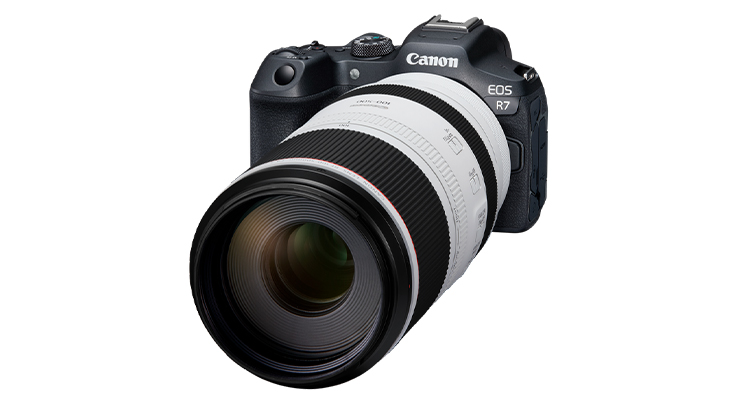
With a new line of APS-C cameras blossoming, we can expect new lens additions to accommodate the new sensor. With that, Canon will release new RF-S lenses, a new line designed for the smaller APS-C sensor size of the R7 and R10.
However, do note that these lenses will be able to be used on any camera from the R-Series.
Canon RF-S18-45mm F4.5-6.3 IS STM and RF-S18-150mm F3.5-6.3 IS STM
Two lenses will be available at launch with the new cameras, and they’re the RF-S18-45mm F4.5-6.3 IS STM and RF-S18-150mm F3.5-6.3 IS STM lenses.
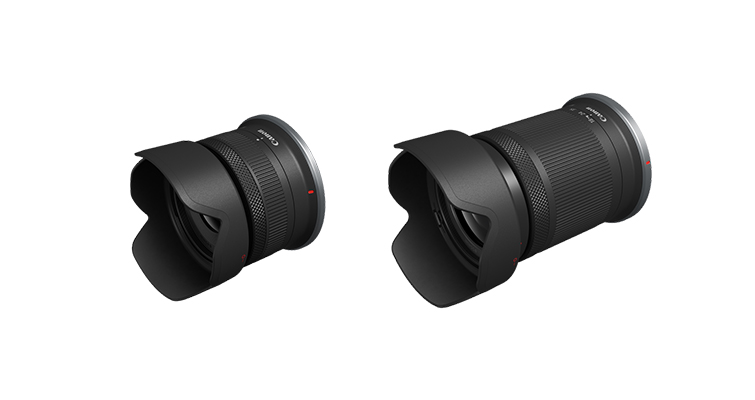
The RF-S 18-45mm provides an 18-45mm focal length, but users will experience a field of view equivalent to 29- 72mm lens coverage on a full-frame camera.
The RF-S18-150mm lens is a longer-range standard zoom, equivalent to 29-240mm lens coverage on a full-frame. While ideal for the new EOS R10 and EOS R7 APS-C sized sensor bodies—these lenses can be used for any R-series camera.
– Canon
- The RF-S18-150mm F3.5-6.3 IS STM lens will be available for an estimated retail price of $479.00
- The RF-S18-45mm F4.5-6.3 IS STM lens will have an estimated retail price of $299.99
RF-S 18-45mm F4.5-6.3 IS STM key features:
- RF-S standard zoom lens with 29 – 72mm focal length (35mm equivalent).
- Lens retraction mechanism for compact design.
- In-lens optical stabilization with coordinated control for 6.5-stops when used with EOS R7.
- Leadscrew type STM for smooth movie AF.
- Distortion correction and minimized chromatic aberration.
RF-S 18-150mm F3.5-6.3 IS STM key features:
- High magnification RF-S zoom lens with 29 – 240mm focal length (35mm equivalent).
- Maximum magnification of 0.59x in MF mode.
- In-lens optical stabilization with coordinated control for 7-stops of IS when used with EOS R7.
- Leadscrew type STM for smooth movie AF.
- Distortion correction and minimized chromatic aberration.
More to Come
You’ll be able to pick up the 18-45mm as a kit packaged with the R10 for a steal of $1,099. That’s just $120 more from the R10s asking RRP—making it Canon’s least expensive R series package to date.
Overall, I’d maybe wager that there’s not anything in these cameras for those who are regular readers of this blog. And that’s fine. But for those looking to leave behind the Rebel DSLR line or maybe buy their first camera, I think the R10 package deal is a great place to start.
All products will be available in late 2022.
For more on Canon, check out these articles:
- NAB 2022: Canon C300 Mk III and C500 Mk II Receive C2C Firmware Updates
- The R5 vs. R5 C vs. C70: Comparing Canon’s (Very) Similar Cameras
- Canon Announces New Cinema Camera: EOS R5 C
- Say Goodbye to the Canon DSLR
- How to Fix a Stuck Pixel on the Canon C300 Mk III
Cover image via Canon.