
Jargon Basics: The Different Types of Roles in the Video Industry

Let’s run down the positions and roles you’ll need to fill to staff a successful video production operation and adequately break down the different types of video production businesses.
While it may be true that the majority of us got into the film and video business based on our love of the art of filmmaking, the cruel lesson we all eventually have to learn is that this industry is about making money.
Now, if you only work on art films and passion projects, more power to you—but you’re one of the lucky few. Still, just because film and video can quickly become a product and service like anything else, it doesn’t mean you still can’t have fun and apply your artistic instincts and expertise to your corporate and commercial projects.
To that end, let’s look at the different types of video production (and post-production) businesses in this film and video space. From a full turnkey video production agency to a niche post-house, here are all the different types of video production companies and roles within them—and why these options might be suitable for your needs.
Production Companies
Let’s start by talking about the different types of production companies that exist in the video business. These are the types of companies that focus on actually shooting and producing video content in one way or another. And while you might at first think this is just one type of business, there are tons of different kinds of video production on which a company can focus on.
Here are some of the many different types of niche and specialty video production companies:
- A/V Rental
- Event Video
- Wedding Films
- Documentary
- Narrative (shorts and features)
- Corporate
- Commercial
- Educational
- Real Estate
- YouTube content
- Influencer / Social Content
As you can see, these different types of videos run the gamut from high-end productions (like commercial and corporate videos, which can sometimes have budgets ranging from $100,000+) to DIY specialties like YouTube and social influencer content (which can be shot on smartphones and with minimal resources).
However, we highlight this myriad of niches as a way to showcase the advantages of being flexible in the types of productions you can create and stress the importance of focusing on your niche.
For example, suppose you’re working on a lot of event videos. In that case, many of your skill sets and resources might be equally valuable in taking on wedding films or other documentary types of projects. Whereas if you’re shooting strictly high-end commercial work, you could look at making that your brand and even working with large-scale corporate clients on more diverse video needs.
Turnkey Production Companies
Before we move on to the types of post-production houses and companies, we also need to discuss turnkey production companies that handle all aspects of video production from script to screen. While many production companies might aim to offer this wide variety of services, it does require a good deal of expertise and resources.
However, as digital filmmaking has become more accessible and easy to learn, many of this new generation of filmmakers (aka shreditors—shooters, producers, and editors) can offer these full-scale projects to clients.
Still, as you might grow your own brand, it will quickly snowball. Your bandwidth to handle each section of a video’s production might start to thin. That could require you to build a team and company much more quickly than you expect.
Post-Production Companies
Now it’s time to talk about the vast array of post-production companies that can be found in the professional video editing space. While many production agencies or turnkey companies can offer essential video editing services, in certain situations, there might come a time you need to turn to specialized companies that can handle the different niches of post-production.
Some examples of the different types of post-production companies include:
- Animation
- Motion graphics and VFX
- Color correcting and grading
- Sound design
- Sound effects
- Voice-over and ADR
- Sound mastering
Even with these different niches, a well-versed video editing company can handle most of these needs with today’s modern post-production toolsets. However, they might need different team members who can specialize in different aspects like VFX and animation, color correcting and grading, or sound design and mastering.
What Type of Video Production Company is Right for You?
Now that we’ve gone over all the different production companies types, we can finally ask the question that might be most important to you. What type of production company is right for you and your needs?
If you’re an aspiring filmmaker turned video professional looking to find your spot and niche, seeing so many types of roles and jobs can feel a bit daunting. You can always try to learn all the skills and be a true jack-of-all-trades, but that will ultimately require a lot of your time and necessitate you learning some insane project management tricks.
However, if you feel drawn to one specific area of either production or post, you can always focus on that niche and genuinely aspire to master the craft. If you’re a great animator or a talented director of photography, you’ll always be able to find work and partner with other creatives who specialize in their arenas.
Suppose you’re someone trying to understand the nuances of video production (like a client or producer, perhaps). In that case, it’s at least beneficial to learn these different types of companies and roles so you’ll know who to reach out to for specific projects. While a turnkey production company might promise you the least worries, they can often be the most expensive.
Yet, if you want to mix and match the needs of your project with different specialists, you better at least plan to hire a Producer to usher your video through the various stages.
It’s about understanding your projects, skills, and needs and finding the best paths and people to create the best films and videos possible.
Roles Found At Production Companies
Many video production companies start small, but that doesn’t mean creating a video production company is a small task. You obviously need a lot of capital, gear, and equipment. And, if you’re going to scale your operation and take on bigger, more lucrative projects, you will need people. You’re going to need to staff a good team.
With that in mind, let’s take a look at the individual roles that make up the staff of a standard video production company.
(It’s worth noting that these are “generalized” roles. As you build your company, you’ll no doubt create your hybrid roles while prioritizing what’s important “now” versus down the line.)
Sales/Client Manager
At a certain point, you’ll want someone to act as the point person for your company. They’ll handle some networking, and scouting, and actively work to secure new clients and projects. Often, this is the very figurehead of the company itself. It could be you, the founder, an original member, or someone with a sales background who likes the challenge of an excellent old-fashioned cold-call.
This role includes:
- Cold calls and networking.
- Leading meetings and sales presentations.
- Client management and communication.
- Working on hitting sales quotas.
- Working closely with producers.
Producer
Once your sales staff has a new production locked down, you’ll need a dedicated project manager — known as a producer in the video world — to handle the business of putting the production’s pieces together and seeing it through to completion. Others will be involved, but your producer will play a key role in keeping communication clear and ensuring everything stays on schedule.
It’s important to hire a producer over a project manager. Producers have deeper understanding of the production and post-production process. They have a specialized skillset that will make the difference when compared to a more generalized project manager.
This role includes:
- A great deal of film and video knowledge into all parts of production.
- Strong communication skills with clients.
- Pre-production skills for organizing a project.
- Scheduling and budgeting skills.
- Consolidating and organizing all the relevant footage and assets needed for a project.
- Working closely with the director to finalize the project scope, schedule, and budget.
Director
Every film and video project needs a solid director at the helm, someone who can visualize, communicate, and oversee every aspect of a project’s production from start to finish. The director can be a full-time, in-house employee or someone brought in (often at the client’s request) for a specific project. Either way, the director’s ultimate responsibility is to deliver a quality product.
Let’s here from the super talented David F. Sandberg on the topic.
This role includes:
- A great deal of film and video knowledge into all parts of production.
- Strong communication skills to work with cast and crew.
- A creative mind and the ability to think quickly on set.
- Exceptional problem solving capabilities.
- Working closely with the director of photography and the rest of the crew heads or members.
Director of Photography
A director of photography (DP) usually acts as the right-hand-man of the director and oversees everything in the camera department. Using all the gear, equipment, and crew on hand, the DP is responsible for ensuring every shot is of the utmost quality. The DP will work with the director on storyboards, shot lists, and shooting schedules as they plan a project out.
This role includes:
- An expert understanding of different film and video cameras and gear.
- A high level of knowledge of the art of cinematography, composition, and lighting.
- Strong communication skills to work with the director and the rest of the camera crew.
- Working closely with the camera operator, the gaffer/lighting department, and anyone else involved in getting a great shot.
Camera Operator
While it’s a role often filled by the DP, many professional video shoots have a dedicated camera operator (who sometimes works alongside an assistant camera operator). The camera operator physically operates the camera and related gear—tripods, gimbals, Steadicam, etc. An assistant would ideally handle a follow focus or additional support when available.
This role includes:
- Excellent knowledge of different cameras and related gear.
- Strong camera skills for handling a camera, framing a shot, and setting focus.
- Listening and communicating skills between the DP and any assistants.
Gaffer/Lighting Crew
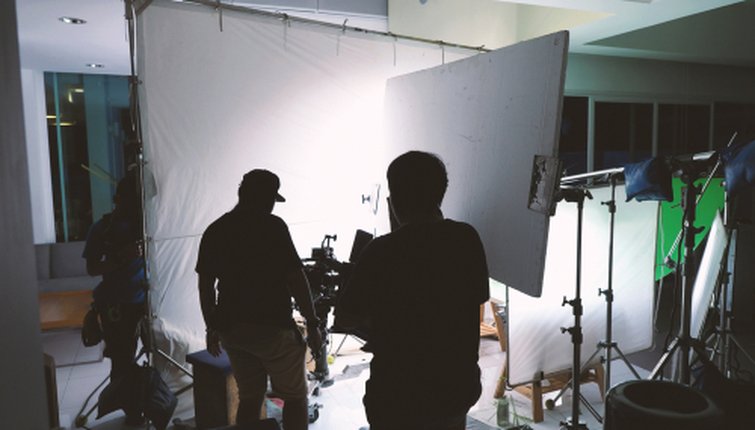
A gaffer (also called the chief lighting technician) is responsible for setting lighting on a film or video project. The gaffer works with the DP and handles the setup, maintenance, and safety precautions for all the lighting on set. Depending on the size of the shoot, the gaffer might be in charge of a lighting department and crew.
This role includes:
- Excellent knowledge of lighting gear and uses.
- Robust safety protocols for properly setting up, using, and breaking down lights.
- Communication skills with the rest of the crew and any assistants.
- Working closely with the DP and director to modify lighting for each shot, as needed.
Audio Technician and Sound Recording
This is another role that involves a whole department on a prominent feature, but often just one or two people on a small project. An audio technician will be in charge of all the audio and sound recording on a project. Ideally, an audio technician will work with a boom operator (or another sound artist) to decide what microphones to use and where to mix and record as needed properly.
This role includes:
- Excellent knowledge of audio recording and sound design.
- Familiarity with all manner of microphones and mixers.
- Communication skills with the rest of the crew and any assistants.
- Working closely with the director to ensure all the audio is recorded correctly, as well as the DP to ensure no microphones are visible in any shot.
Editor/Editing Supervisor

Once production wraps, the producer will bring all the footage and assets to an editor or editing supervisor, who then creates a post-production workflow. On many sets, a digital-imaging technician (DIT) will handle footage as it comes in and might even get started on a rough edit.
This role includes:
- Excellent knowledge of relevant video editing platforms.
- A strong understanding of editing theory and digital assets.
- A creative mind for storytelling and problem-solving any issues with footage.
- Working closely with the producer and any additional post-production roles like motion graphics and/or coloring.
Motion Graphics/VFX
In many of the production companies I’ve worked with, animations beyond basic motion graphics (lower thirds, logos, etc.) were sent out to a motion graphics expert or VFX artist. Once complete, these additional graphics are sent back to the editor or editing supervisor to be included in the final renders.
This role includes:
- Background in motion graphics and VFX design.
- Proficiency in advanced platforms like After Effects, Cinema 4D, Nuke, etc.
- Working closely with the producer or editing supervisor to go over any templates or storyboards, as well as providing feedback and reviews.
Colorist

Finally, in addition to motion graphics, advanced color correction, and color grading would go to a separate specialist, sometimes to speed up the workflow. The colorist works with the final draft of a project to lock down the designed color aesthetic and look.
This role includes:
- Background in color theory and cinematic coloring.
- Proficiency in color grading platforms like DaVinci Resolve, Red Giant Colorista, and/or Adobe Color software.
- Working closely with the producer and editing supervisor for final color corrections and grading.
Staff Up
Again, the roles above are common and generally accepted as best practice, but they aren’t carved in stone. Get imaginative when building your team, and find ways to cut costs without sacrificing the quality of your work. Ultimately, no matter what your org chart looks like, just make sure it’s populated by creative collaborators you know you can count on.
For more film and video industry insight, check out these articles below.
- Essential Gear You Need to Start Your Own Production Company
- Getting Hired for a Video Production Company Job
- The Pros and Cons of Forming a Production Company
- 7 Things Clients Look For in a Video Production Company
- 6 Tips for Marketing Your Video Production Company
Cover image via Aofchin.